Tell us about the job
Takes about a minute. No obligation.
A furnace in McPherson County cycles its burner and ignition system hard, and the heat exchanger accumulates fatigue in a way that shows up in mid-life repairs as cracks or stress points a contractor can see. Homes in McPherson County, KS run heat about seven months a year, from October through April. By the time a furnace here needs repair, the ignition system and burner assembly are the first places a contractor checks, because those are the parts that have been starting, firing, and shutting down across that long run. A unit that was installed slightly undersized or without a proper commissioning will show stress there sooner than the age of the equipment would suggest.
Furnaces in housing stock this old have typically been replaced at least once since the house was built, which means the unit a contractor opens bears no necessary relation to what the house was originally designed around. Half the homes in McPherson County, Kansas were built in 1974 or earlier (2020-2024 ACS 5-year). What that creates for repair work is a parts question: the system running in the house is old enough that certain components are discontinued, and a contractor working through a diagnosis has to confirm availability before a repair scope is final. A job that looks straightforward at the thermostat can stall at the supply chain.
The Parts of a Furnace a Contractor Checks First
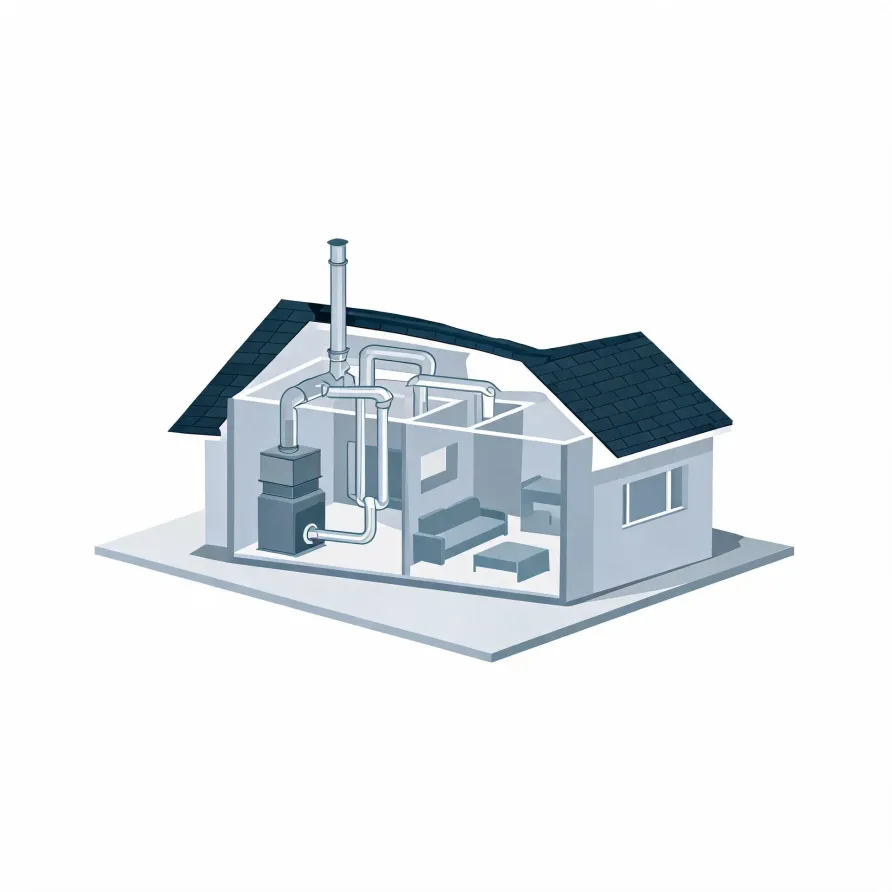
The heat exchanger sits at the heart of the furnace cabinet, in whatever utility space the unit occupies, and it is where combustion heat passes into the air stream. When it cracks or warps, you may notice uneven heating or a smell. The burner assembly fires directly beneath it, and a contractor will pull it early when a furnace stops producing heat or ignites poorly.
The blower motor and its fan wheel sit in the lower section of the cabinet and push conditioned air into the duct system. The control board, mounted inside the same cabinet, reads every sensor and tells each component when to act. A failed board can mimic symptoms from almost anywhere else in the furnace, which is why a contractor checks it alongside the limit switch and the inducer motor before moving further.
The drawing shows the general layout of a furnace system, and a licensed contractor determines which components apply and what condition they are in for your specific home.
Get matched in McPherson CountyMcPherson County, by the numbers
221 severe weather events were recorded in McPherson County, Kansas between 2015 and 2024.
NOAA National Centers for Environmental Information, Storm Events Database, bulk CSV export, events 2015-01-01 through 2024-12-31.Half the homes in McPherson County, Kansas were built in 1974 or earlier (2020-2024 ACS 5-year).
U.S. Census Bureau, 2020-2024 American Community Survey 5-Year EstimatesMcPherson County, Kansas holds 13,176 housing units (2020-2024 ACS 5-year).
U.S. Census Bureau, 2020-2024 American Community Survey 5-Year EstimatesOwners occupy 75.5% of the occupied homes in McPherson County, Kansas (2020-2024 ACS 5-year).
U.S. Census Bureau, 2020-2024 American Community Survey 5-Year EstimatesCodes & Standards Covering Furnace Repair in McPherson County, Kansas4 sourced rules and standards
What Happens When a Contractor Comes Out
Non-weatherized gas furnaces manufactured on or after November 19, 2015 must reach 80.0 percent AFUE.
Non-weatherized oil-fired furnaces manufactured on or after November 19, 2015 must reach 83.0 percent AFUE.
Mobile home gas furnaces manufactured on or after November 19, 2015 must reach 80.0 percent AFUE.
Non-weatherized gas furnaces manufactured on or after December 18, 2028 must reach 95.0 percent AFUE, up from the 80.0 percent minimum that applies to units manufactured before that date.
Severe Weather Events in McPherson County, Year by Year
Kansas weather puts real stress on heating equipment. Hard conditions accelerate wear, and a furnace that has been working against the local climate builds up a service history that a contractor here will recognize.
221 severe weather events, 2015–2024. Source: NOAA National Centers for Environmental Information, Storm Events Database.