Tell us about the job
Takes about a minute. No obligation.
A furnace contractor diagnosing a repair in Saline County has to decide whether a failed component wore out on schedule or gave up ahead of time. Homes in Saline County, KS run heat about seven months a year, from October through April. The burner, the heat exchanger, and the ignition system cycle through that entire span every year, and the wear on them accumulates in ways that show up differently depending on how the system was installed and sized. A cracked heat exchanger on an older unit is a different conversation than one on a unit that should have years left, and the repair scope, and the cost, follow from that distinction.
Furnaces in houses this old tend to show their history at the heat exchanger first. Cracks, scaling, and carbon deposits there are the product of decades of cycling, and they are what a contractor is actually pricing once the cabinet is open. Half the homes in Saline County, Kansas were built in 1966 or earlier (2020-2024 ACS 5-year). That housing age means the equipment running in it now was almost certainly retrofitted into a system built around something different, so the burner assembly and the venting it connects to get checked before any other number goes on a quote.
The Parts of a Furnace a Contractor Checks First
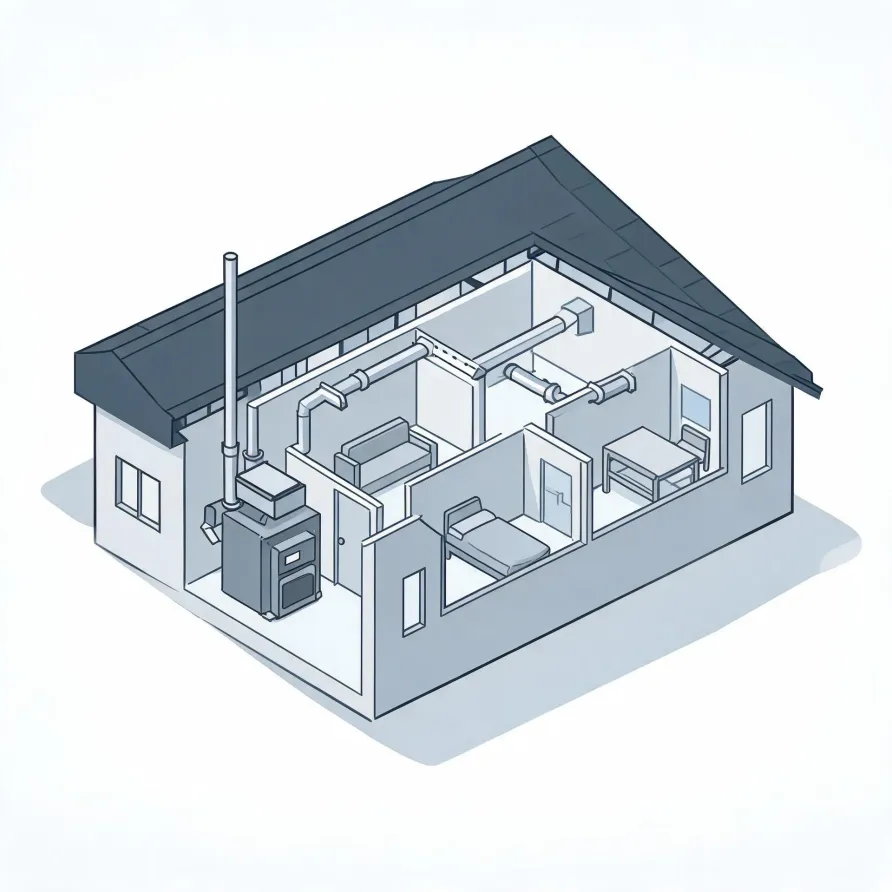
The heat exchanger sits at the core of the furnace cabinet and is the piece a contractor examines closely when a system runs but does not heat properly or when carbon monoxide is a concern. The burner assembly sits just below it, and when ignition fails or flames burn uneven, that is where the work begins.
The blower motor sits at the base of the cabinet and pushes conditioned air out through the supply plenum above. The flue pipe runs from the top of the cabinet to the exterior and carries combustion gases out. Both are checked when a furnace cycles oddly, runs without moving air, or produces unfamiliar sounds.
The drawing shows a typical furnace layout, and a licensed contractor determines which components apply to the specific equipment and configuration in your home.
Get matched in Saline CountySaline County, by the record
211 severe weather events were recorded in Saline County, Kansas between 2015 and 2024.
NOAA National Centers for Environmental Information, Storm Events Database, bulk CSV export, events 2015-01-01 through 2024-12-31.Half the homes in Saline County, Kansas were built in 1966 or earlier (2020-2024 ACS 5-year).
U.S. Census Bureau, 2020-2024 American Community Survey 5-Year EstimatesSaline County, Kansas holds 24,157 housing units (2020-2024 ACS 5-year).
U.S. Census Bureau, 2020-2024 American Community Survey 5-Year EstimatesOwners occupy 67.1% of the occupied homes in Saline County, Kansas (2020-2024 ACS 5-year).
U.S. Census Bureau, 2020-2024 American Community Survey 5-Year EstimatesCodes & Standards Governing Furnace Repair in Saline County, Kansas4 sourced rules and standards
What happens when the contractor comes out
Non-weatherized gas furnaces manufactured on or after November 19, 2015 must reach 80.0 percent AFUE.
Non-weatherized oil-fired furnaces manufactured on or after November 19, 2015 must reach 83.0 percent AFUE.
Mobile home gas furnaces manufactured on or after November 19, 2015 must reach 80.0 percent AFUE.
Non-weatherized gas furnaces manufactured on or after December 18, 2028 must reach 95.0 percent AFUE, up from the 80.0 percent minimum that applies to units manufactured before that date.
Severe Weather Events in Saline County
Extreme weather puts real strain on furnace components, from heat exchangers to igniters to pressure switches. How hard that equipment works over time is a local fact, and this county's storm record is part of that picture.
211 severe weather events, 2015–2024. Source: NOAA National Centers for Environmental Information, Storm Events Database.