Tell us about the job
Takes about a minute. No obligation.
A furnace repair quote in Stanton County starts with what the burner and heat exchanger have already been through. Homes in Stanton County, KS run heat about seven months a year, from October through April. That kind of sustained cycling stresses the ignition system and the heat exchanger more than any other components, and a contractor working a furnace here checks both before pricing anything else. Cracks in the heat exchanger and a degraded igniter are not surprises on a system that has been lighting off and shutting down through cold after cold. A short idle period in summer is all the rest the equipment gets.
Ductwork in a house carries the history of every system that has run through it, and in Stanton County that history is long. Half the homes in Stanton County, Kansas were built in 1968 or earlier (2020-2024 ACS 5-year). A furnace that has been replaced once or twice in a house like that is likely sitting on duct transitions, plenums, and seals that were fitted for something earlier, and when a repair opens the unit, what the contractor finds at those connections shapes what the job actually costs. A cracked heat exchanger or a failed inducer is a parts question. Duct joints pulling away from the plenum are a separate repair the original call did not budget for.
The Parts of a Furnace a Contractor Checks First
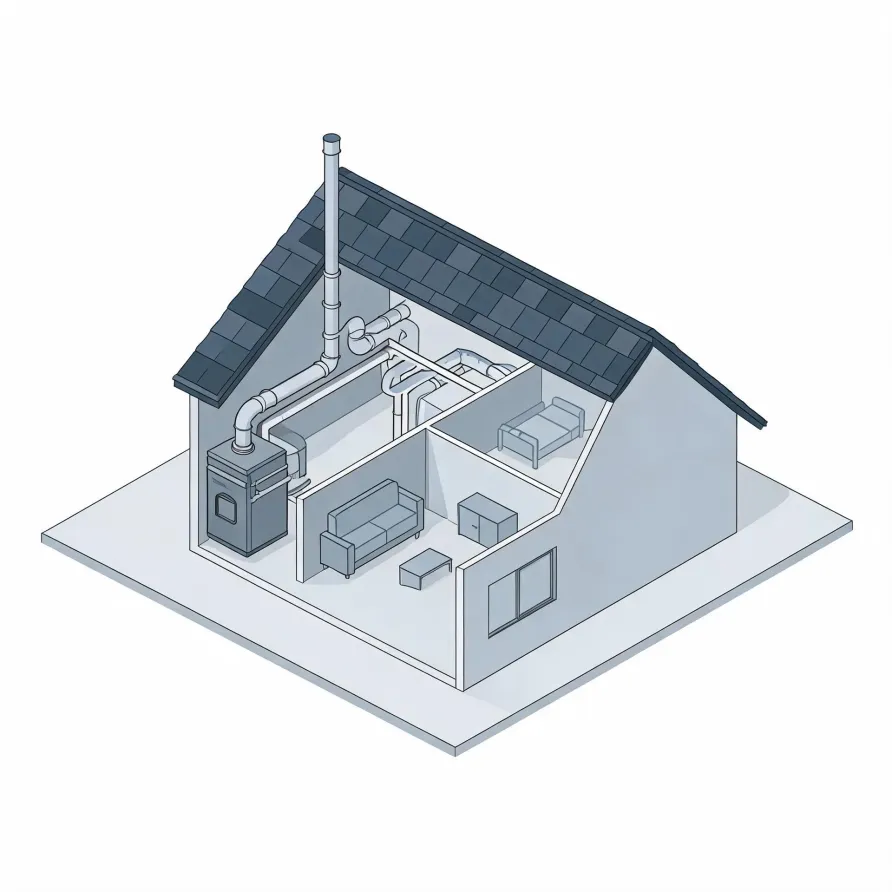
The furnace itself sits in a utility space, basement, or closet and is the piece a contractor goes to first. Inside it, the heat exchanger and burner assembly are the most common sources of trouble. A cracked heat exchanger, a dirty burner, or a failed igniter will each stop the system in its own way, and a contractor reads the symptoms to know which one to look at.
The blower motor moves conditioned air out of the furnace cabinet and into the supply side of the house. The flue or vent pipe runs from the furnace to the outside and carries combustion gases away. Both are checked during a repair call because a seized blower or a blocked flue can mimic the same symptoms as a failed burner.
The drawing shows a typical furnace layout, and a licensed contractor determines what applies to the specific equipment and configuration in your home.
Get matched in Stanton CountyStanton County, by the numbers
126 severe weather events were recorded in Stanton County, Kansas between 2015 and 2024.
NOAA National Centers for Environmental Information, Storm Events Database, bulk CSV export, events 2015-01-01 through 2024-12-31.Half the homes in Stanton County, Kansas were built in 1968 or earlier (2020-2024 ACS 5-year).
U.S. Census Bureau, 2020-2024 American Community Survey 5-Year EstimatesStanton County, Kansas holds 1,029 housing units (2020-2024 ACS 5-year).
U.S. Census Bureau, 2020-2024 American Community Survey 5-Year EstimatesOwners occupy 76.5% of the occupied homes in Stanton County, Kansas (2020-2024 ACS 5-year).
U.S. Census Bureau, 2020-2024 American Community Survey 5-Year EstimatesCodes & Standards Governing Furnace Repair in Stanton County, Kansas4 sourced rules and standards
What Happens When a Contractor Comes Out
Non-weatherized gas furnaces manufactured on or after November 19, 2015 must reach 80.0 percent AFUE.
Non-weatherized oil-fired furnaces manufactured on or after November 19, 2015 must reach 83.0 percent AFUE.
Mobile home gas furnaces manufactured on or after November 19, 2015 must reach 80.0 percent AFUE.
Non-weatherized gas furnaces manufactured on or after December 18, 2028 must reach 95.0 percent AFUE, up from the 80.0 percent minimum that applies to units manufactured before that date.
Severe Weather Events in Stanton County
Stanton County weather puts real stress on heating equipment: temperature swings, storms, and extended cold all add hours to a furnace's running time and wear on its parts. How hard the local climate pushes that equipment shapes how often it needs attention.
126 severe weather events, 2015–2024. Source: NOAA National Centers for Environmental Information, Storm Events Database.