Tell us about the job
Takes about a minute. No obligation.
Sizing a furnace for Edwards County starts with understanding what the burner and heat exchanger are actually being asked to carry. Homes in Edwards County, KS run heat about seven months a year, from October through April. A contractor quoting a new install has to work out whether the existing duct layout and equipment capacity can handle that kind of sustained cycling, because a system that is undersized or loosely commissioned will push its ignition components and heat exchanger harder than the manufacturer's ratings assume. Wear on those parts accumulates with use, and a long heating season gives it little chance to level off.
Ductwork in a house this old was designed around whatever unit the builder specified at the time, and what a furnace contractor finds behind the registers now is rarely a clean match for a modern system's output and airflow requirements. Half the homes in Edwards County, Kansas were built in 1948 or earlier (2020-2024 ACS 5-year). That gap between what the duct system was built to move and what a new furnace actually demands is where an installation either runs on schedule or stalls while a contractor reworks runs, resizes returns, or flags an electrical service that was not wired for a current draw this size. The equipment choice matters, but the ductwork decides the scope.
What Gets Installed With a New Furnace
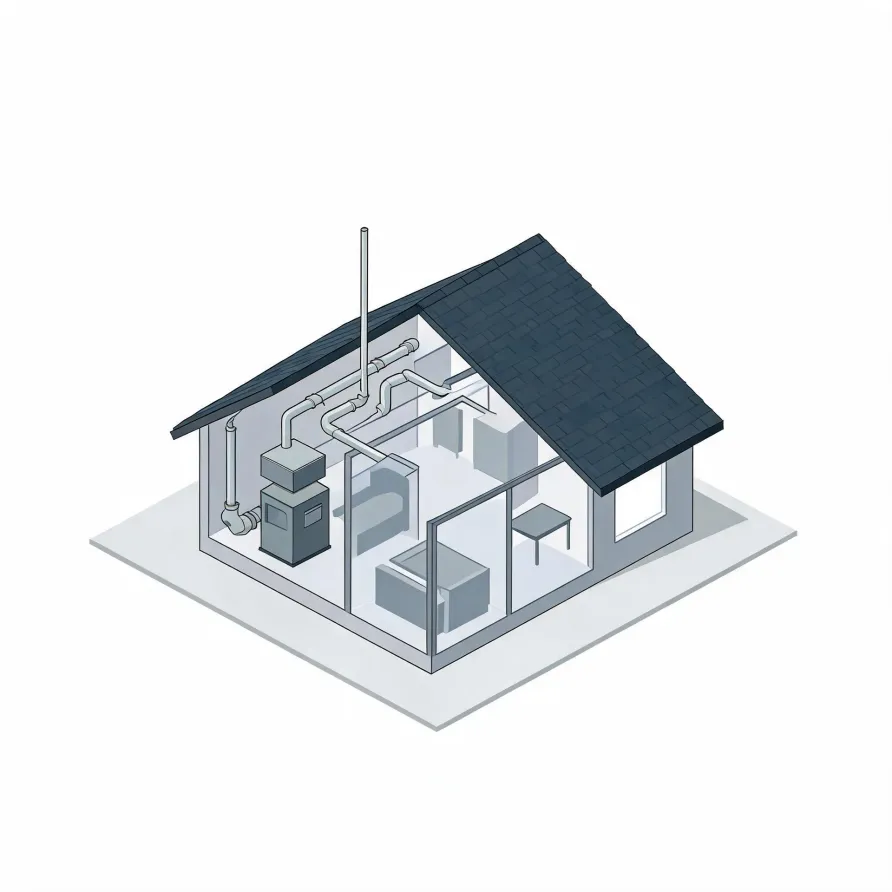
The furnace itself sits in the basement, utility room, or a dedicated mechanical closet and is the unit a homeowner sees when they walk into that space. Inside it, a heat exchanger and a blower work together: the exchanger produces the heat, and the blower pushes conditioned air into the supply side of the house. A gas valve and a burner assembly connect to the home's fuel line at the base of the unit.
The flue pipe runs from the furnace up through the house and out through the roof or an exterior wall, carrying combustion gases out of the living space. Alongside the furnace sits the air handler or filter cabinet, depending on the configuration, and at the base of the return air path a fresh filter housing receives the filter that the homeowner replaces on a regular schedule. A thermostat, mounted on an interior wall, ties the whole system together by telling the furnace when to fire.
The drawing shows a typical layout, and a licensed contractor determines what the configuration looks like in your specific home.
Find a contractor in Edwards CountyEdwards County, by the numbers
122 severe weather events were recorded in Edwards County, Kansas between 2015 and 2024.
NOAA National Centers for Environmental Information, Storm Events Database, bulk CSV export, events 2015-01-01 through 2024-12-31.Half the homes in Edwards County, Kansas were built in 1948 or earlier (2020-2024 ACS 5-year).
U.S. Census Bureau, 2020-2024 American Community Survey 5-Year EstimatesEdwards County, Kansas holds 1,549 housing units (2020-2024 ACS 5-year).
U.S. Census Bureau, 2020-2024 American Community Survey 5-Year EstimatesOwners occupy 79.2% of the occupied homes in Edwards County, Kansas (2020-2024 ACS 5-year).
U.S. Census Bureau, 2020-2024 American Community Survey 5-Year EstimatesFurnace & HVAC Installation Rules for Edwards County, Kansas4 codes & standards
What the Installation Actually Looks Like
Non-weatherized gas furnaces manufactured on or after November 19, 2015 must reach 80.0 percent AFUE.
Non-weatherized oil-fired furnaces manufactured on or after November 19, 2015 must reach 83.0 percent AFUE.
Mobile home gas furnaces manufactured on or after November 19, 2015 must reach 80.0 percent AFUE.
Non-weatherized gas furnaces manufactured on or after December 18, 2028 must reach 95.0 percent AFUE, up from the 80.0 percent minimum that applies to units manufactured before that date.
Severe Weather Events in Edwards County
Weather patterns in Edwards County put real demands on heating equipment, from hard winters that run furnaces long and often to the kind of temperature swings that wear on components over time. What a furnace handles here is a local question, and that history is worth knowing before installation decisions get made.
122 severe weather events, 2015–2024. Source: NOAA National Centers for Environmental Information, Storm Events Database.