Tell us about the job
Takes about a minute. No obligation.
A contractor diagnosing a furnace repair in Scott County starts with the burner and heat exchanger, because those are the parts that cycle every time the system fires. Homes in Scott County, KS run heat about seven months a year, from October through April. Repeated firing and cooling stresses metal and seals in ways that add up across a long run of cold months. Cracks in a heat exchanger and ignition system wear are the faults a contractor finds most often, and they find them in those parts first, not because the equipment is old on paper, but because the burner has simply done a lot of work.
Furnaces in older stock tend to carry what every previous owner left behind: swapped components, non-original heat exchangers, and wiring that was extended rather than replaced. Half the homes in Scott County, Kansas were built in 1959 or earlier (2020-2024 ACS 5-year). A contractor opening a furnace in a house like that is not looking at a system in its original configuration. What they find determines whether a repair is a straightforward part swap or a job that surfaces a second problem once the first is fixed. Parts availability for equipment that has been running through successive owners is the variable that sets the scope, and that scope is not knowable from the outside.
The Parts of a Furnace a Contractor Checks First
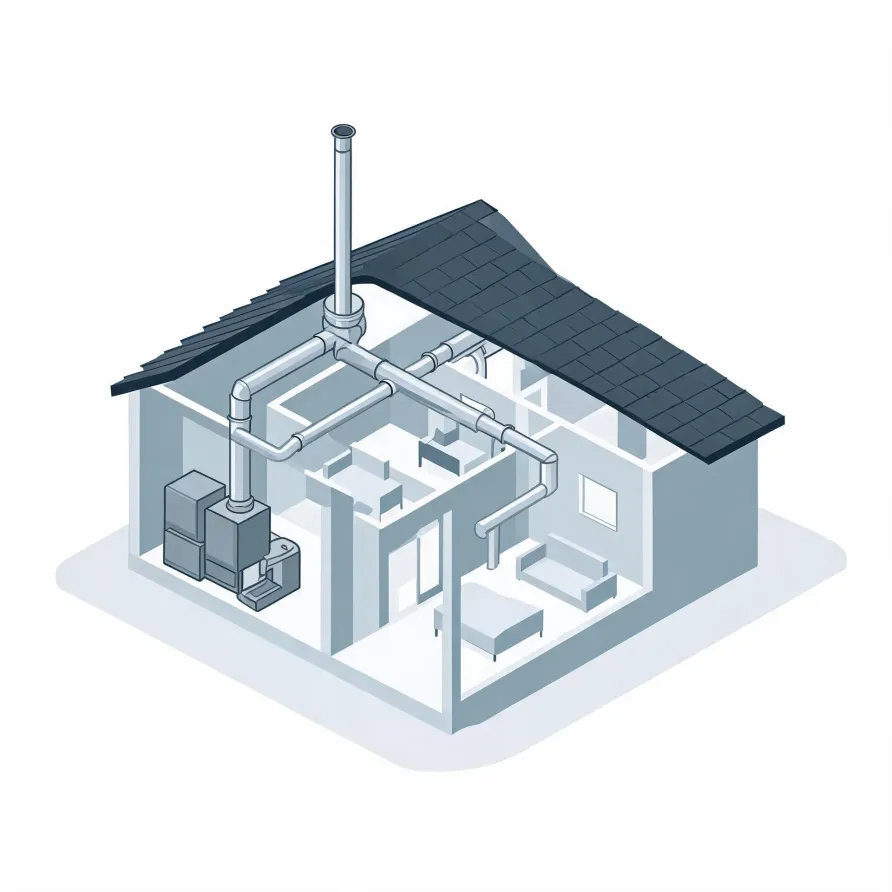
The heat exchanger sits at the core of the furnace cabinet in your basement or utility room. It is the first place a contractor looks when a furnace runs but does not warm the house, because cracks in that metal shell let combustion gases into the airstream. The burners sit just below it, and a failed ignitor or a dirty flame sensor there is often what keeps the furnace from lighting at all.
The blower motor and its fan wheel sit at the base of the cabinet and push conditioned air out through the supply side of your duct system. The control board rides inside the cabinet as well, reading signals from the thermostat and telling every other part when to act. When a contractor cannot pin the problem on a single component, the board and its wiring connections are where the diagnostic work usually lands.
The drawing shows a typical furnace layout, and a licensed contractor determines which components apply to your specific system and what condition each one is in.
Get matched in Scott CountyScott County, Kansas, by the numbers
217 severe weather events were recorded in Scott County, Kansas between 2015 and 2024.
NOAA National Centers for Environmental Information, Storm Events Database, bulk CSV export, events 2015-01-01 through 2024-12-31.Half the homes in Scott County, Kansas were built in 1959 or earlier (2020-2024 ACS 5-year).
U.S. Census Bureau, 2020-2024 American Community Survey 5-Year EstimatesScott County, Kansas holds 2,334 housing units (2020-2024 ACS 5-year).
U.S. Census Bureau, 2020-2024 American Community Survey 5-Year EstimatesOwners occupy 67.2% of the occupied homes in Scott County, Kansas (2020-2024 ACS 5-year).
U.S. Census Bureau, 2020-2024 American Community Survey 5-Year EstimatesCodes & Standards Covering Furnace Repair in Scott County, Kansas4 sourced rules and standards
What Happens When a Contractor Comes Out
Non-weatherized gas furnaces manufactured on or after November 19, 2015 must reach 80.0 percent AFUE.
Non-weatherized oil-fired furnaces manufactured on or after November 19, 2015 must reach 83.0 percent AFUE.
Mobile home gas furnaces manufactured on or after November 19, 2015 must reach 80.0 percent AFUE.
Non-weatherized gas furnaces manufactured on or after December 18, 2028 must reach 95.0 percent AFUE, up from the 80.0 percent minimum that applies to units manufactured before that date.
Severe Weather Events in Scott County
Kansas weather puts real stress on heating equipment, and Scott County has its own pattern of conditions that shape how hard a furnace has to work and how often it gets pushed to its limits. What happens outside directly affects what wears out inside, which is why local repair demand follows local weather.
217 severe weather events, 2015–2024. Source: NOAA National Centers for Environmental Information, Storm Events Database.