What to do when the heat goes out in Junction City, KS
Get matched with a pro who fixes furnaces in Geary County.
A furnace that quits in Junction City in January is not a small problem. Cold air moves in fast, and most homes here run on gas, so a dead furnace usually means a real safety check is needed, not just a reset switch.
You could start calling around, but that takes time you do not have when the house is dropping ten degrees. Each call means explaining the same thing again: what the furnace is doing, what it is not doing, how old the system is, whether you smell gas or just feel cold air coming from the vents.
That is the part this page skips for you. Tell it what is going on once, and it matches you with a contractor who works on furnaces like yours in Geary County. They will reach out to you directly, so you are not stuck waiting by the phone or sorting through quotes from people who may not even serve Junction City.
Winters here are cold enough that a furnace issue rarely waits for a convenient day. Whether the igniter failed, the blower will not start, or the thermostat is calling for heat with nothing happening, a contractor who already knows the kind of systems common to this area can look at the actual problem instead of starting from scratch.
You do not have to figure out if it is serious enough to call someone, or try to diagnose it yourself from a furnace manual. That judgment belongs to someone who does this work. What you can do right now is get matched with one.
Fill in what you know about your furnace and your situation below. The next step is simple: a contractor who covers Junction City gets in touch with you.
First, check the thermostat is set to heat and the temperature is above room temperature, then check your breaker panel for a tripped breaker. Gas furnaces also need a working pilot light or electronic igniter, so if the breaker's fine and the thermostat is calling for heat, the problem is likely inside the furnace itself. A dirty flame sensor, a failed igniter, or a clogged filter choking airflow can all shut a furnace down. Winters in Geary County get cold enough that a night or two without heat can mean frozen pipes, so this isn't something to leave for later. Because most homes here run on gas, a furnace that won't light often means there's a safety lockout protecting you from a bigger problem, and that calls for someone who can check the gas line and venting along with the furnace itself, not just swap a part and hope.
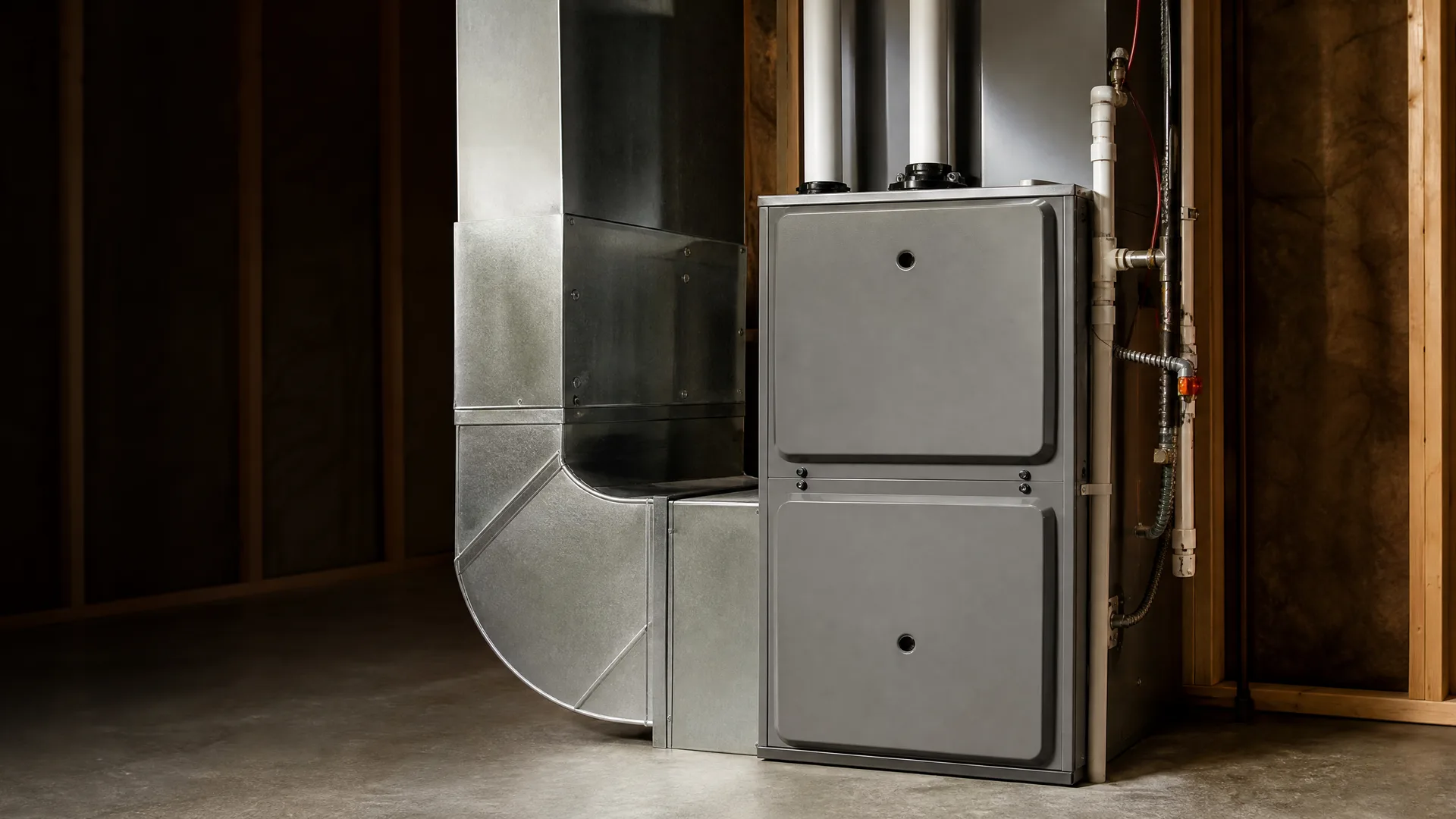
A furnace like this is doing its job: the flue pipes, gas valve, and drain line are all in place with nothing leaking or loose.
Dust and age alone won't stop a furnace, but a cabinet like this has had years to develop a cracked igniter or a failing limit switch.
Why does my furnace blow cold air instead of heat?
You go to the vent and feel air moving, but it is not warm. In a Junction City winter that is unsettling fast, because the system sounds like it is running and nothing about it looks broken from where you stand. Before you assume the whole furnace is shot, it helps to know what actually has to happen between the blower turning on and warm air reaching the room.
Usually the burners never lit, so the blower is pushing unheated air
A gas furnace lights the burners first, then waits for the heat exchanger to warm up before the blower turns on. If that sequence breaks anywhere, the blower can still run on schedule while the air passing over the exchanger stays cold. A dirty flame sensor will shut the gas valve off within seconds of ignition, so you get a short burst of warmth followed by cold air. A clogged filter or blocked vent can also trip a limit switch that cuts the burners but leaves the blower running to clear the ducts. Either way, the fix is at the burner assembly or the airflow path, not the blower itself.
Geary County data puts the average overnight low at 21°F across December, January and February. That is the temperature your furnace is working against most nights, not just on the coldest one. A furnace running that often, that hard, wears on its igniter and its blower motor faster than a mild winter would, and when one of those parts finally gives out, it usually does it overnight, when the house is coldest and everyone's asleep. If yours quits now, you don't have to spend the morning calling shops and repeating the same story to each one. Answer a few questions about what's going on and a contractor who covers Junction City will reach out to you directly.
A furnace that won't fire at 21 degrees overnight doesn't wait for a convenient week. You've already checked the thermostat and the breaker, maybe reset it twice, and it's still blowing cold or not blowing at all. The next step most people take is a search, then five phone calls, then explaining the same dead igniter or tripped limit switch to five different people, then sitting with quotes you have no way to judge against each other. That's hours you don't have while the house cools down. A furnace that's run through a few Kansas winters has earned the kind of wear that needs a trained eye, not a guess over the phone. Handing the search off means one contractor who works in Junction City gets your situation once, and calls you back with it, instead of you repeating yourself to a string of strangers while the thermostat keeps losing the argument with the cold outside.
What a working igniter does
A furnace lights by sending voltage through the igniter until it glows hot enough to catch the gas, usually in under a minute. That part cycles on and off every time the thermostat calls for heat, so over a winter it heats and cools hundreds of times. Each cycle stresses the material a little more. When it finally cracks, the furnace will often still run its blower and go through the motions, but the burners never light, and you get air moving with no heat behind it.
Why the limit switch matters
The limit switch shuts the burners off if the furnace gets hotter inside than it should, usually from blocked airflow at the filter or a duct that is not moving enough air. It is a safety part, not a convenience one, so a furnace will not run without it working correctly. If it trips repeatedly or fails, the furnace may shut down mid-cycle or refuse to start at all, which looks the same from the vent as a dead igniter but comes from a different cause.
Winter nights average 21°F
At 21 below freezing most winter nights, your furnace can't just idle and coast till morning. It has to hit that gap and hold it for hours, call after call, all night. A furnace that's struggling will show it first on nights like these.
NOAA nClimDiv 1991-2020
What a cold house costs you overnight
A furnace that quits at 10pm doesn't wait until morning to matter. By 2am a house in Geary County can lose heat fast enough that rooms farthest from the furnace feel it first, kids' rooms, a nursery, wherever the ducts run longest. You end up layering blankets, running space heaters off one outlet, checking on everyone twice before dawn. None of that fixes the furnace. It just gets the household through the night while the real problem, whatever shut the system down, waits for someone licensed to look at it.
What else is riding on this
Pipes are the other risk when a house goes cold for hours. Water lines on outside walls or in an uninsulated crawlspace can freeze and split long before the inside air feels unbearable to you. A furnace that's out overnight in a Junction City winter isn't just a comfort problem, it's a plumbing problem waiting to happen. That's worth knowing before you decide a repair can wait until a more convenient day. The households that catch this early are the ones who call for a diagnosis instead of running space heaters for a week and hoping.
Where this leaves you
A dead furnace in Junction City starts with the thermostat, the breaker, and the pilot light or igniter, in that order.
A furnace that lights but blows cold, or won't fire at all on a 21 degree night, points to a part that's failed, not a setting that's wrong.
Geary County winters run on gas furnaces working hard most nights from December through February, and that workload is what wears parts down.
Finding a licensed contractor means skipping the calls to five companies and repeating the same symptoms each time.
Matching with a contractor who knows gas furnaces in this area saves the work of sorting quotes and checking licenses yourself.
Once you're matched, the contractor reaches out to you instead of you chasing down availability during a cold snap.
You've gone through the thermostat, the breaker, and the pilot light or igniter. If none of that got the furnace running, the problem is in a part, not a setting, and that part needs a licensed hand on it. That's true whether the furnace is blowing cold air or not firing at all on a night in the low 20s. Geary County furnaces earn their keep from December through February, running hard most nights, and a part that's been wearing down all winter tends to fail on the coldest nights, not the mildest ones. That's not bad luck. It's the part finally giving out under the load it's been carrying for weeks.
From here, the choice is between doing the legwork yourself or handing it off. Doing it yourself means calling around to find a contractor who's licensed and actually works on gas furnaces, explaining the same symptoms to each one, then comparing quotes and sorting out who to trust, all while the house stays cold. Getting matched with a contractor skips that part. You describe the problem once, get matched with someone who works on furnaces like yours in this area, and they reach out to you. You're not left checking licenses or waiting on hold during a cold snap. The furnace still needs a real repair. What changes is how much work it takes to get someone qualified to your door to do it.