
How long a furnace lasts in Kansas City, KS

Step 1 of 3: Equipment

How long does a furnace last in Kansas City, KS?

Your furnace has been running a while and you're wondering if it's getting close to the end, or maybe it just failed and you want to know if replacing it makes more sense than another repair. Either way, you want a straight number to plan around, not a vague range that could mean anything.

15 to 20 years, most gas furnaces in Wyandotte County

Most gas furnaces last 15 to 20 years, and that holds true in Wyandotte County as much as anywhere. Winters here are cold enough that your furnace runs hard for months at a stretch, and that steady workload is what wears out the heat exchanger and the other parts that do the actual heating. A furnace that gets regular care tends to land at the higher end of that range. One that's been ignored, or one that's been short-cycling for years, can fail earlier. If your furnace came with the house and you don't know its age, the data plate inside the cabinet will have a manufacture date. Past 15 years, a repair bill is worth weighing against the cost of starting over with a new unit.

A gray high-efficiency furnace with white PVC vent pipes stands on a concrete pad in a basement, beside sheet-metal ductwork, copper piping and a poured concrete wall with wood framing at left.

Still doing its job

A furnace like this heats evenly and starts up without hesitation. The burners light on the first try, the blower runs quiet, and the gas line and condensate piping stay dry and tight. If yours still looks and runs like this, a yearly checkup is probably all it needs.


A beige gas furnace in a basement with a metal flue pipe, galvanized sheet-metal ductwork to its left, and gas and water pipes along the concrete wall to its right.

Running on borrowed time

An older furnace like this one works harder to do the same job. Rust on the cabinet, a flue pipe showing its age, or a burner that takes a couple of tries to catch are signs it's wearing out. Once repairs start adding up, replacement is worth a real look.

Why does a Wyandotte County furnace wear out as fast as it does?

  • Winter nights average 23°F

    Winter nights average 23°F here, so the burners and blower run hard and long to hold a warm house against that cold.

  • Heat runs October through April

    Homes here run heat about seven months a year, October through April, which adds up to a lot more cycles than a furnace in a milder state ever sees.

  • 67.5% of homes heat with gas

    67.5% of homes in Wyandotte County heat with gas, so most furnaces here are gas furnaces logging those long months of runtime.

NOAA nClimDiv 1991-2020 · ACS 2020-2024

What happens inside after years of this

A furnace heats by pulling flame across a metal heat exchanger, and that metal expands every time the burners fire and contracts every time they shut off. After years of that cycle, seven months a year, the metal gets brittle and can crack. A cracked heat exchanger is why furnaces get replaced instead of repaired. It is not a part a contractor can patch and trust. Once it goes, the only honest fix is a new unit. That failure usually shows up as the furnace running fine one winter and needing full replacement the next, with no slow warning in between.

What a furnace built for this cold is up against

A furnace sized and installed for Wyandotte County winters is working against 23°F nights for months at a stretch, longer and colder than a furnace in a milder state ever sees. That is more hours on the burners and blower each year than the same unit would log somewhere warmer, and more hours is what shortens a furnace's life. A furnace installed by someone who works on this equipment in this county every winter gets sized and set up for that load from the start, which matters more here than in a place where the furnace barely runs half the year.

A gray-haired bearded man in a dark coat and scarf dusted with snow stands smiling in a dimly lit entryway with a white front door, a side table with a lit lamp, an oval mirror, and a patterned rug.
An older bearded man in a dark snow-dusted coat and gray scarf stands just inside a dimly lit home entry, with a framed picture, lit table lamp, and an adjoining room with a fireplace behind him, and snow visible through the open door.
A gray-haired, bearded man in a dark snow-dusted coat stands smiling in a dimly lit entry hall with a staircase, a lit table lamp, a framed picture, and a living room visible through a doorway.
An older man with gray hair and a beard, wearing a dark jacket dusted with snow, stands smiling in a dimly lit hallway with lamps and a living room visible behind him.

An old furnace shows up in the house before it fails outright. Rooms at the far end of the ductwork stay a few degrees cooler than the rest, so you find yourself adding a space heater in the bedroom or closing off a vent that never gets warm anyway. The blower runs longer to make up for a weaker heat exchanger, and that shows up on the gas bill before anything breaks. Some mornings the burners take a second try to light, a short delay you'd miss if you weren't standing in the kitchen listening for it. If the furnace quits on one of those 23°F nights, you're not looking at a quiet repair call, you're looking at a cold house until someone can get a new one in. A furnace that's already struggling has less room to handle a hard freeze, which is exactly when you need it most. None of this means yours is done. It means it's worth knowing which of these you're already seeing.

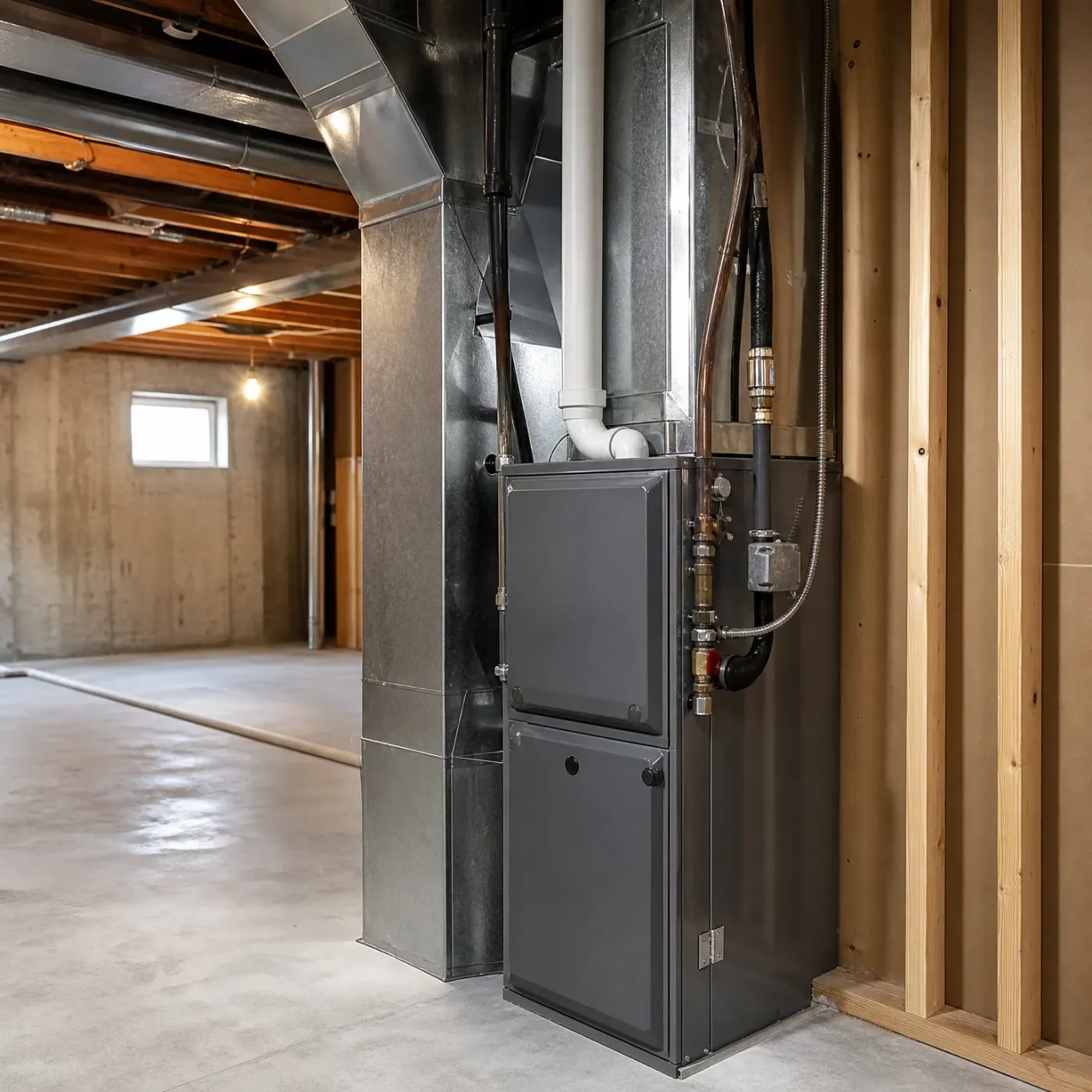
A gray high-efficiency furnace stands on a concrete basement floor beside sheet-metal ductwork, with white PVC vent pipes and a black flexible line running up to exposed wood floor joists, next to a wood-framed post against a concrete wall.
A newer furnace like this holds a steady flame and keeps the heat exchanger and flue connections clean and tight.
A beige metal furnace with a louvered front panel stands on a concrete floor against a concrete wall, connected to galvanized sheet-metal ductwork and a metal pipe.
An older furnace like this, with black iron gas pipe and a round flue, is the age where failure becomes a real risk.

Is your furnace telling you something right now

Walk through your house on a cold morning and pay attention to what you hear and smell. A burner that takes a few tries to light, a burning dust smell that doesn't go away after the first few minutes, or a blower that rattles or hums louder than it used to are all worth noting. So is a thermostat set to 70 in a room that's sitting at 66. None of these mean the furnace is about to quit, but they're the kind of thing that gets worse through the winter, not better, and a cracked heat exchanger or a gas leak isn't something you want to find out about by smell alone.

  1. Thermostat calls for heat and opens the gas valve

  2. Igniter glows or sparks to light the burners

  3. Burners heat the metal heat exchanger inside the cabinet

  4. Blower motor pushes air across the hot heat exchanger

A woman wrapped in a thick beige fleece blanket sits on a sofa with an open book on her lap, beside a lit table lamp, with a frost-covered window behind her.
A gray-haired woman in a cream knit sweater stands in a dimly lit kitchen at night, looking to her right, with a round loaf of bread in the foreground and a dark window and potted plant behind her.
A gray furnace with copper and flexible piping stands against a wood-framed wall in an unfinished basement, connected to galvanized sheet-metal ductwork and PVC venting, with a concrete floor and exposed joists.

Get matched with a furnace pro in Wyandotte County

The pro who gets in touch is licensed in Kansas and works in Wyandotte County.

A local installer who puts in furnaces gets your project.

Request a pro

It costs nothing to send, and you don't have to hire anyone.

An older beige furnace with louvered front panels stands on a concrete basement floor beside galvanized ductwork, metal and plastic pipes, exposed wood framing, and a cylindrical water heater at right.
Before you get your furnace installation
A gray high-efficiency furnace in a basement with PVC vent pipes, sheet-metal ductwork, copper and insulated pipes, a water heater at left, and an unfinished wood-stud wall at right.
After you get your furnace installation

Repair the one you have

A repair makes sense when the furnace is still within its years and the failure is a single part, an igniter, a flame sensor, a draft inducer. A licensed contractor can replace that part and the furnace goes back to heating the house the way it did before. This holds up if the heat exchanger is still sound and the rest of the unit has been running clean. You keep the furnace you know, and you avoid the work of sizing and installing a new system before you actually need one.

Replace it this time

Replacement makes more sense once the furnace is old enough that another repair just buys a little time before the next one. A cracked heat exchanger, repeated failures, or a furnace that's been struggling for a few winters already all point the same direction. A local contractor who installs these every winter can look at your specific furnace and tell you honestly which side of that line you're on, and walk you through sizing a new one for your house rather than guessing at what fits.

Winter nights average 23°F

A 23°F night means your furnace runs long stretches just to hold the house at 70. It doesn't get much rest once the sun goes down. Years of those long nights wear on the heat exchanger faster than a mild winter ever would.

NOAA nClimDiv 1991-2020

A gray high-efficiency furnace with two access panels stands in a bare basement corner, connected to sheet-metal ductwork, white PVC vent pipes, and flexible gas and electrical lines.

Keep the age in mind

A furnace that still lights and heats fine can still be worth replacing on your schedule instead of its own. If yours is old enough that a major part failing would mean a new system anyway, waiting for that failure means doing it in the cold, without time to compare anything. Replacing it while it still runs lets you pick the timing.

A gas furnace with metal ductwork, copper and yellow gas piping stands against a wall in an empty room with a bare concrete floor.

Waiting for the failure

The other path is running it until it actually quits, then dealing with whatever that means that day. Sometimes that's a part a contractor can swap in an afternoon. Sometimes the heat exchanger itself has cracked and the whole unit needs to go. You don't know which one you'll get until it happens, and it tends to happen on the coldest night, not the easiest one.

A smiling man in a denim shirt and white t-shirt stands in an open dark doorway of a stucco house, facing a woman with long brown hair and a green jacket seen from behind in the foreground.

So where does that leave your furnace

A furnace in Wyandotte County holds up for a stretch of years, then the heat exchanger and the gas piping start showing their age, and from there a failure on a cold night is a matter of when, not if. You know by now which side of that line yours is on, or close to it.

If yours is getting old or already telling you something, a local contractor who works on these furnaces all winter can look at what you have and tell you straight whether it's worth another repair or time to replace it. Answer a few questions about your house and you'll be matched with one licensed contractor near Kansas City who takes it from there, not a handful of companies competing for your number.

A gray upholstered sofa with a matching cushion sits beside a potted plant and a wooden table holding a small green plant in a stone pot, near a curtained window.
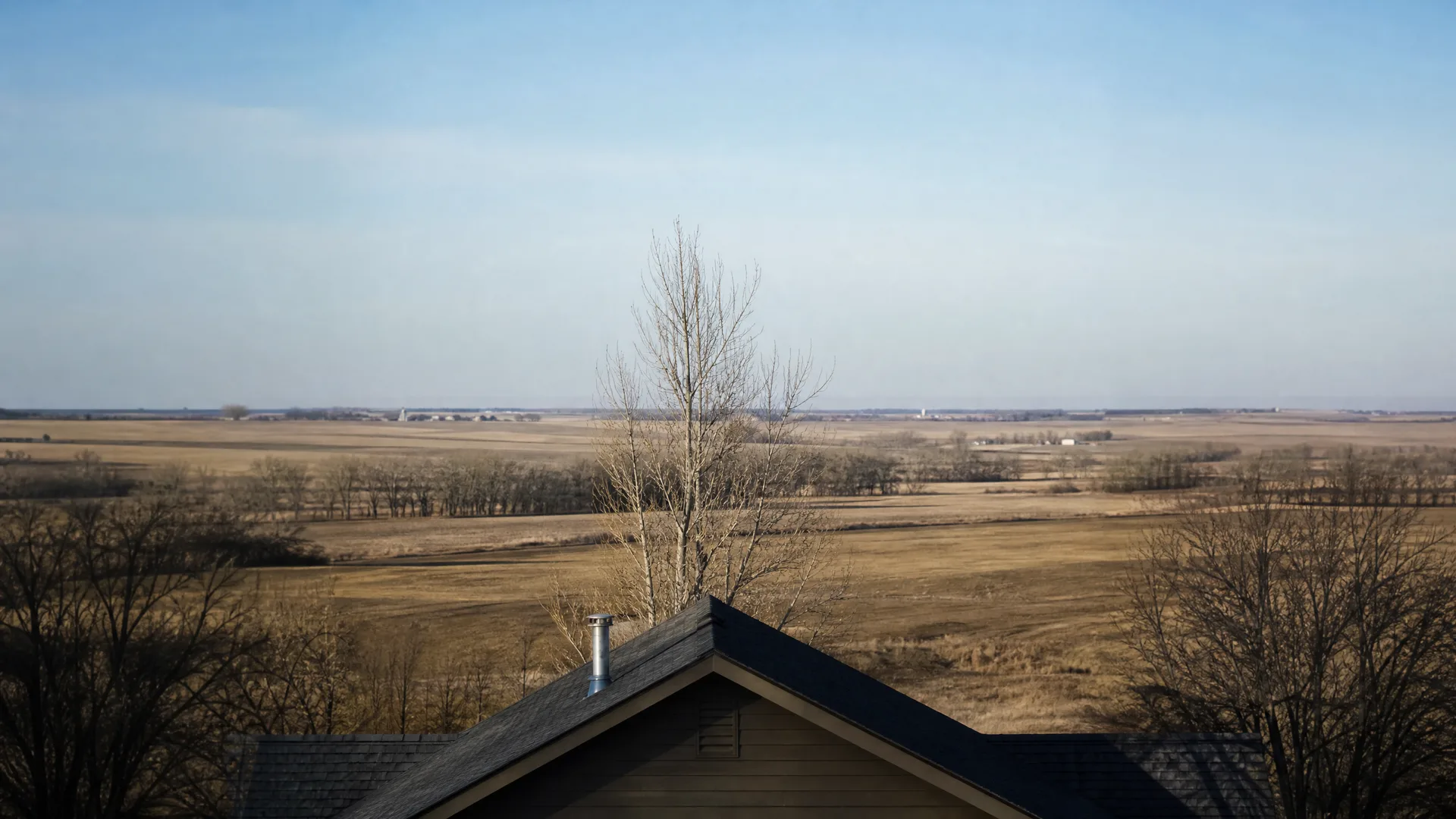
View over a dark shingled gable roof with a metal flue pipe toward flat brown fields, bare trees, and a hazy horizon under a pale blue sky.

Find a furnace installation pro in Wyandotte County

Reach a local pro

No charge to send it. You decide if you hire them.

A furnace that fails on a cold night doesn't wait for a convenient morning to do it. Getting a quote now, before that happens, means you already know who's coming and what it costs, instead of scrambling for anyone who can show up the same day.