Tell us about the job
Takes about a minute. No obligation.
Homes in Elk County, KS run heat about seven months a year, from October through April. A furnace burner cycles on and off through all of those months, and the ignition system trips every time it does. By the time a homeowner calls for a repair, the igniter and flame sensor have logged a heavy history of cold-start stress. A contractor working a furnace here prices the repair around those components first, because that is where the wear lands.
Ductwork in a house this old was sized and routed for whatever equipment the original builder specified, and what a contractor pulls out of a furnace often belongs to a lineage of equipment the parts industry has largely moved on from. Half the homes in Elk County, Kansas were built in 1956 or earlier (2020-2024 ACS 5-year). That gap between the building and what replaced the original system is where furnace repair gets complicated: a contractor opening the unit has to establish whether the parts it needs are still in distribution before the repair scope can be priced. A heat exchanger or a control board for a system of that vintage may exist in limited supply, and that determines whether a repair is straightforward or whether it turns into a conversation about what comes next.
The Parts of a Furnace a Contractor Checks First
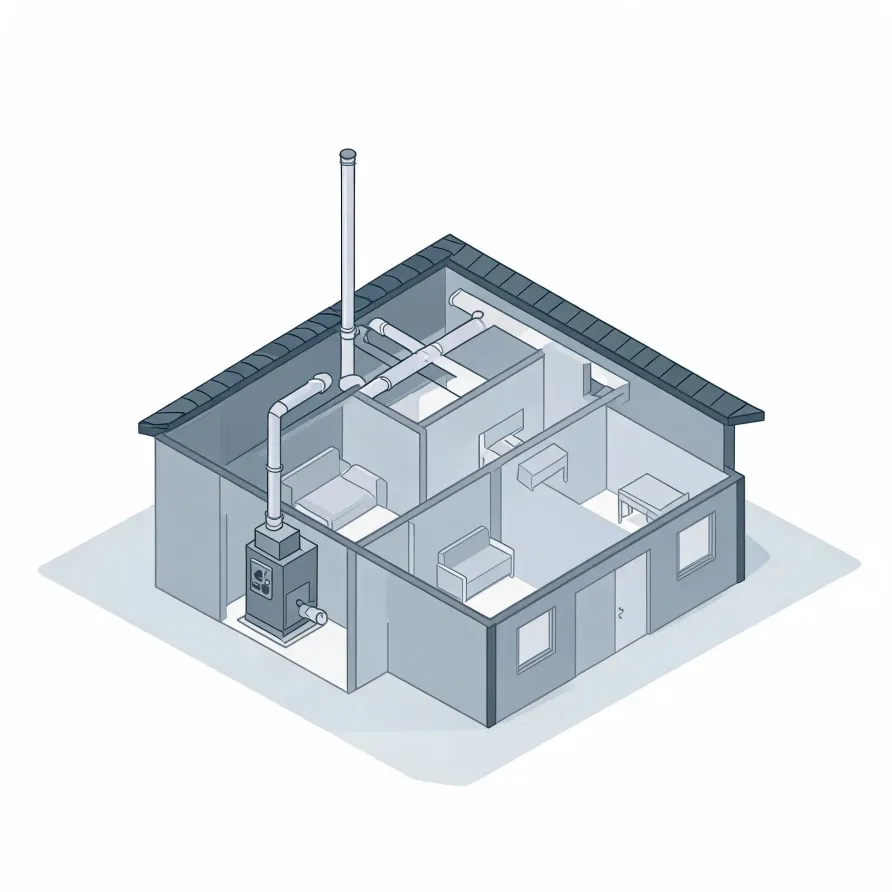
The heat exchanger sits inside the furnace cabinet, usually in a basement, utility room, or closet, and it is the piece that actually warms the air before it moves through the house. Cracks or buildup here are among the first things a contractor looks for. The burner assembly, which sits just below it, is another early stop when a furnace is producing no heat or uneven heat.
The blower motor and its fan wheel sit at the base of the cabinet and push conditioned air into the supply side of the duct system. The control board, mounted inside the same cabinet, is the piece that reads the thermostat signal and tells every other component when to run. A failed board can mimic the symptoms of several other faults, so contractors often check it after ruling out the mechanical parts.
The drawing shows a general furnace layout, and a licensed contractor determines which components apply to your specific system and situation.
Get matched in Elk CountyElk County, Kansas, by the numbers
52 severe weather events were recorded in Elk County, Kansas between 2015 and 2024.
NOAA National Centers for Environmental Information, Storm Events Database, bulk CSV export, events 2015-01-01 through 2024-12-31.Half the homes in Elk County, Kansas were built in 1956 or earlier (2020-2024 ACS 5-year).
U.S. Census Bureau, 2020-2024 American Community Survey 5-Year EstimatesElk County, Kansas holds 1,491 housing units (2020-2024 ACS 5-year).
U.S. Census Bureau, 2020-2024 American Community Survey 5-Year EstimatesOwners occupy 78.8% of the occupied homes in Elk County, Kansas (2020-2024 ACS 5-year).
U.S. Census Bureau, 2020-2024 American Community Survey 5-Year EstimatesFurnace Repair Rules & Codes for Elk County, Kansas4 sourced rules and standards
What happens when a contractor comes out for HVAC repair in Elk County
Non-weatherized gas furnaces manufactured on or after November 19, 2015 must reach 80.0 percent AFUE.
Non-weatherized oil-fired furnaces manufactured on or after November 19, 2015 must reach 83.0 percent AFUE.
Mobile home gas furnaces manufactured on or after November 19, 2015 must reach 80.0 percent AFUE.
Non-weatherized gas furnaces manufactured on or after December 18, 2028 must reach 95.0 percent AFUE, up from the 80.0 percent minimum that applies to units manufactured before that date.
Severe Weather Events in Elk County
Kansas weather puts real stress on furnaces, and Elk County gets its share of conditions that push heating systems hard. How often that happens locally shapes how much repair work the equipment in this area actually needs.
52 severe weather events, 2015–2024. Source: NOAA National Centers for Environmental Information, Storm Events Database.